This post contains affiliate links. If you make a purchase through these links, I may earn a small commission at no extra cost to you. I only recommend items that align with the quality and intention of The Curated Corners.
I’ve spent the week revisiting our library shelves to pull together a collection that captures the quiet awe of the night sky. For children in 2nd and 3rd grade, space books for kids needs to be more than a list of picture books; it’s about creating a sanctuary where big, celestial questions feel safe and welcome. Whether you lean toward the technical precision of a telescope guide or the narrative warmth of an astronaut’s journey, you are giving your 2nd or 3rd grader the tools to look up and see a universe that is as beautiful as it is vast.
Selecting the right books for this age group is about balancing that transition from whimsical picture books to more grounded, factual exploration. Around age seven or eight, children start to look at the moon and realize it’s a physical place they could theoretically stand on. They begin to ask about the “why” behind the stars, and they deserve resources that meet that hunger with quality and intention rather than just bright colors and loud fonts. These are the volumes that don’t just sit on a shelf; they live on the bedside table, their corners softening with the love of a thousand page-turns.
1. How We Got to the Moon by John Rocco
This is an heirloom-quality volume. John Rocco doesn’t just explain the Apollo missions; he invites you into the raw grain of the blueprints and the grit of the launchpad. The illustrations have a tactile, hand-drawn warmth that makes the immense technology of the 1960s feel human and approachable. The focus of this book is on the science, technology and engineering achievements. I love that this isn’t just a book of facts, but a book of discovery. It highlights the actual challenges faced in space and the innovative ways they were solved. It even includes easy, at-home experiments that bring the science to life.
2. 50 Things to See with a Telescope by John A. Read
Stargazing is a practice in patience and presence. This guide is a practical companion for those clear, cold nights in the backyard. It uses “telescope views” to show exactly what a child will see through the lens, removing the frustration and replacing it with the thrill of a successful hunt for the moon’s craters.
3. The Fascinating Space Book for Kids by Lisa Reichley
Sometimes, curiosity strikes in bursts. This collection of 500 facts is perfect for the child who loves to share what they’ve learned. The layout is clean and energetic without being overwhelming, making it a seamless way to weave science into the breakfast table conversation.
4. If You Had Your Birthday Party on the Moon by Joyce Lapin
I love how this book takes a grand, scientific concept—gravity—and grounds it in the familiar ritual of a birthday party. It’s a playful “what-if” that uses humor to explain why your cake would float away, making complex physics feel like a neighborly chat.
5. Mousetronaut by Mark Kelly
Written by a real astronaut, this story about Meteor the mouse reminds us that being small is often a hidden strength. The illustrations by C.F. Payne have a classic, cinematic quality that makes the shuttle interior feel incredibly real. It’s a peaceful reminder of perseverance for any young explorer. Don’t skip the afterword! 📖✨ Astronaut Mark Kelly shares the ‘partially true’ story behind Meteor, including a quick history of animals in space. My kids loved hearing about the real mouse who floated through the shuttle with ease while the others stayed put. It’s a heartwarming lesson in how even the smallest members of a crew are respected and valued.
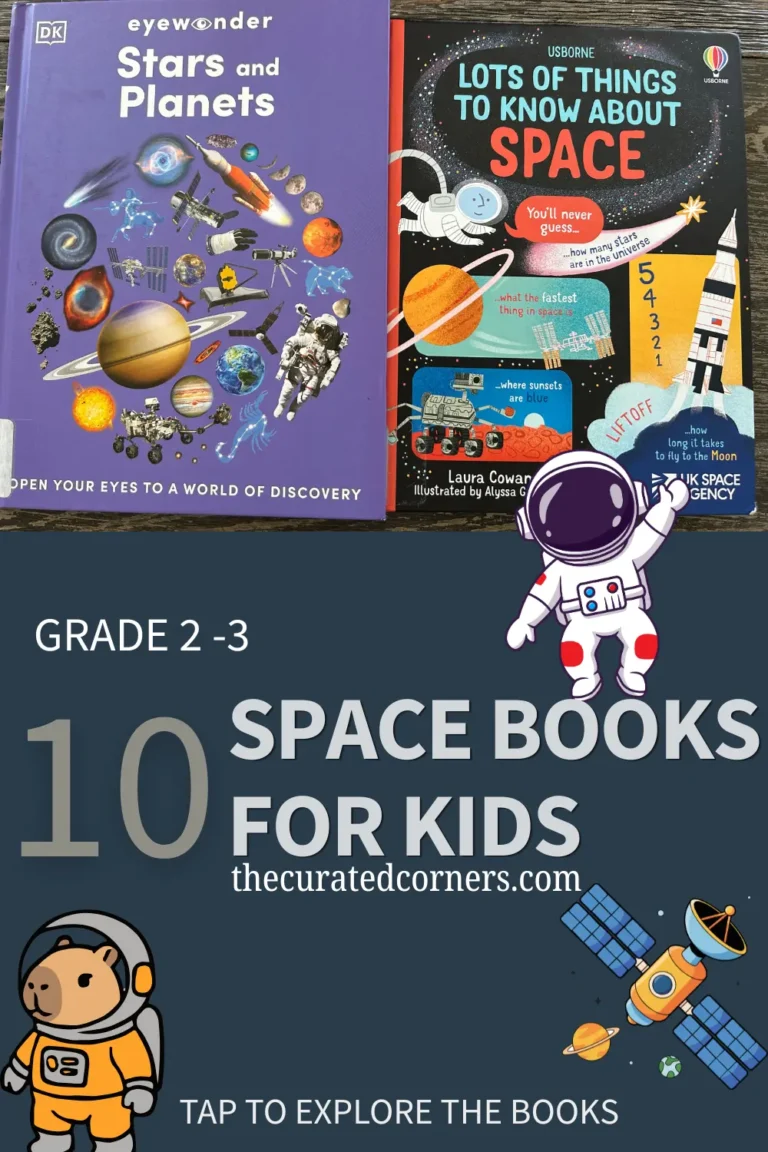
6. Eyewonder: Stars and Planets
Visual learners will gravitate toward the crisp, high-definition photography here. It’s a foundational piece for any home library, offering a clear window into the textures of distant gas giants and the jagged surfaces of asteroids without the cluttered feel of traditional encyclopedias.
7. Lots of Things to Know About Space by Laura Cowan
This book is a masterclass in approachable non-fiction. It breaks down the “why” behind the universe in short, punchy sentences that respect a 2nd grader’s reading level while still tackling big, existential questions about our place in the stars.
8. Astrophysics for Young People in a Hurry by Neil deGrasse Tyson
For the 3rd grader who is ready for more, this adaptation brings the secrets of the cosmos down to earth. The tone is conversational and witty, stripping away the jargon to reveal the raw beauty of physics. It feels less like a textbook and more like a letter from a mentor.
9. Curiosity: The Story of a Mars Rover by Markus Motum
There is something deeply moving about the story of a lonely robot on a red planet. The oversized format and striking, geometric art style make this a visual sanctuary. It’s a grounded look at engineering and the quiet, persistent work of exploration.
10. The Darkest Dark by Chris Hadfield
We end with a story of the heart. Inspired by astronaut Chris Hadfield’s own childhood, this book explores how the awe of the Apollo 11 landing helped a young boy overcome his fear of the dark. It’s a beautiful, textural reminder that the shadows of the night are actually the gateway to the universe.
I’ve always found that the best way to introduce these stories is to let them sit out in the open. Place a book like How We Got to the Moon on a low coffee table or a wooden stool in a sunlit corner. When science is integrated into our physical environment with intention and beauty, it stops feeling like a chore and starts feeling like a lifelong ritual of discovery.
I hope these selections bring a little more wonder to your bedtime routine and a bit of peace to those curious “why” questions that always seem to pop up at dusk.